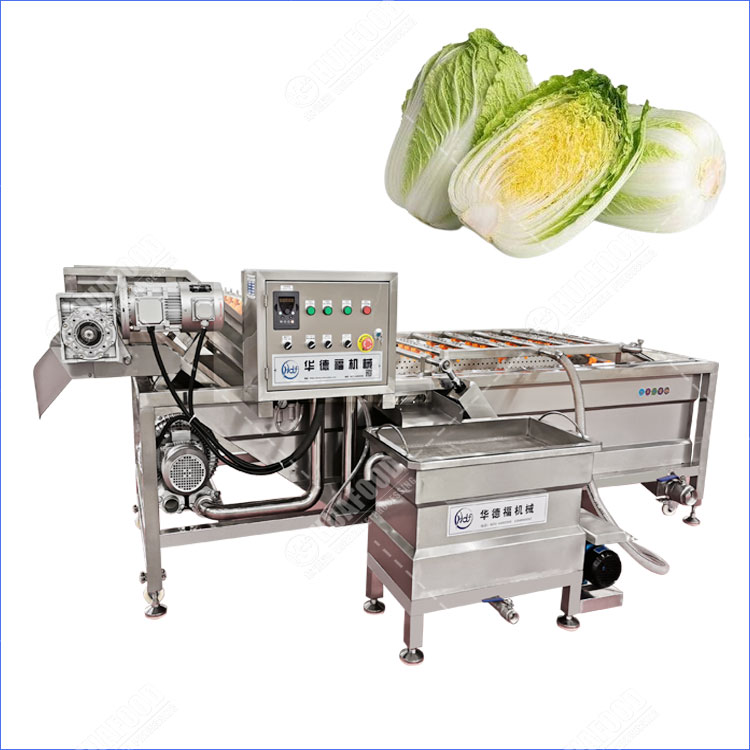
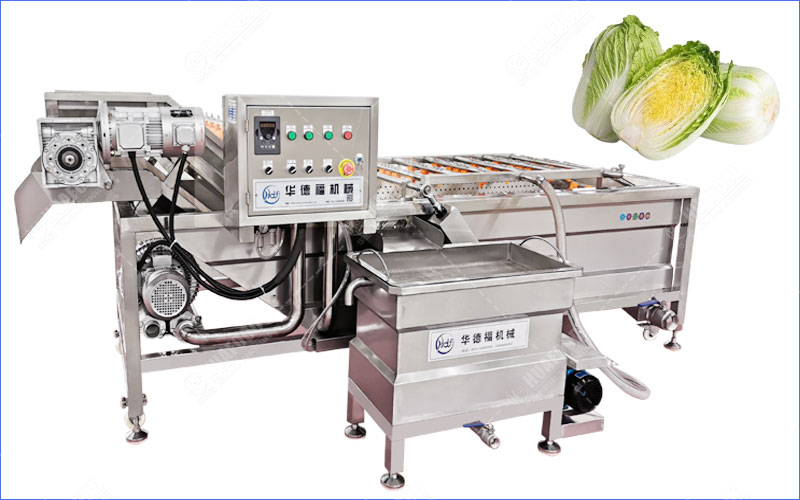
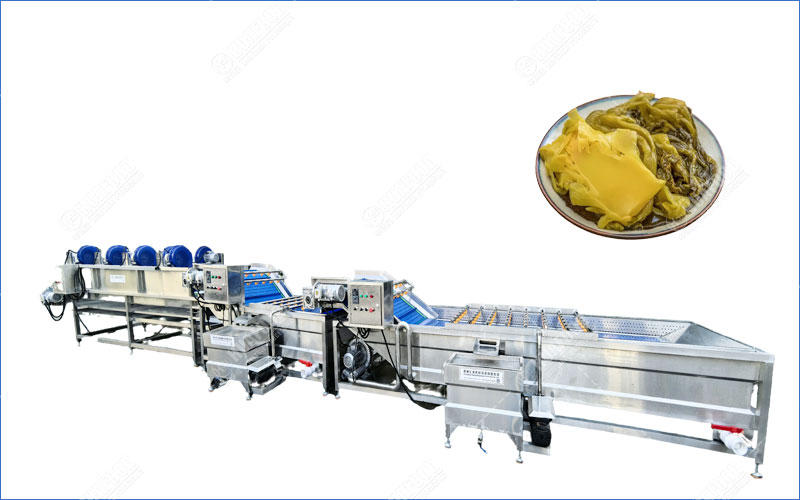
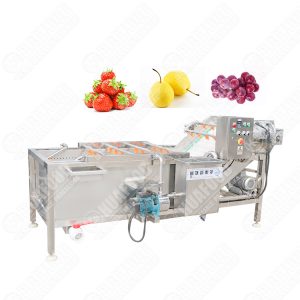
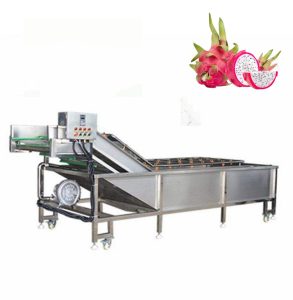
O Commercial Napa Cabbage Bubble Vegetable Washing Machine is a specialized industrial-grade cleaning solution engineered to meet the unique challenges of processing napa cabbage (Chinese cabbage, Brassica rapa subsp. pekinensis). Unlike ordinary leafy greens, napa cabbage features densely layered leaves that trap soil, resíduos de pesticidas, and small insects deep between its inner folds—making thorough cleaning a notoriously difficult task. This machine utilizes a high-pressure bubble agitation system combined with a gentle rolling conveyance mechanism to penetrate every leaf layer, ensuring that the final product is impeccably clean while preserving the delicate cell structure and crisp texture that make napa cabbage prized in kimchi production, salad processing, and frozen vegetable manufacturing. Designed for continuous production lines handling 500–2000 kg/h, this machine is the benchmark solution for processors who demand both food safety compliance and minimal product damage.
The machine operates on a bubble-washing + overflow-floatation dual-action principle. Inside the washing tank, a high-power air compressor injects compressed air through hundreds of micro-nozzles distributed across the tank bottom, generating a dense curtain of rising bubbles. As napa cabbage leaves travel through the water bath via a variable-speed mesh conveyor, these bubbles continuously burst against the leaf surfaces, creating micro-turbulence that dislodges dirt, areia, and pesticide residues from both the outer surface and the inner leaf crevices without mechanical scrubbing. Simultaneamente, a counter-current overflow system at the water surface skims floating debris (loose leaves, light impurities) into a collection trough. Heavier contaminants such as grit and sediment settle to the bottom and are periodically discharged through a bottom drain. The gentle water flow combined with bubble action ensures that napa cabbage's fragile outer leaves remain intact while achieving a deep clean that manual washing can rarely match.
High-Density Bubble Diffuser Array
The machine is equipped with a custom-designed lattice of air nozzles positioned at precise intervals along the tank floor. For napa cabbage, whose leaves often carry stubborn clay deposits from field harvesting, this dense nozzle layout ensures that every square centimeter of leaf surface receives direct bubble agitation, eliminating dead zones where dirt commonly accumulates.
Variable-Speed Mesh Conveyor with Gentle Incline
The conveyor belt is constructed from food-grade polyethylene mesh with a pore size optimized to prevent napa cabbage leaf tips from catching or tearing. The speed is adjustable via a frequency inverter, allowing operators to increase dwell time for heavily soiled cabbage or accelerate throughput for lightly soiled product—providing process flexibility that batch washers cannot match.
Auto-Debris Separation System
A multi-stage filtration and water recycling system continuously removes suspended solids from the wash water. A mesh filter catches leaf fragments and coarse dirt, while a hydrocyclone separates fine sand particles. This closed-loop design not only reduces water consumption by up to 70% but also prevents recontamination of clean napa cabbage with previously removed soil.
Aço inoxidável 304 Construction with Rounded Interior
The entire washing chamber, conveyor frame, and water circulation pipes are fabricated from SUS304 stainless steel. All interior corners are radius-welded (R ≥ 10 milímetros) to eliminate bacterial harborage points, and the tank surface is polished to a Ra ≤ 0.8 μm finish—critical for compliance with BRC, IFS, and USFDA food safety standards.
Complete Penetration of Dense Leaf Structures
Traditional spray washers and drum washers fail to reach the inner layers of a tightly packed napa cabbage head. The bubble washing mechanism generates cavitation-like micro-jets that force water into the inter-leaf spaces, carrying away hidden soil and aphids that are invisible to visual inspection. This deep-cleaning capability directly translates to lower microbial counts and fewer foreign matter complaints from end customers.
Virtually Zero Product Damage
Napa cabbage is highly susceptible to bruising—damaged tissue turns brown rapidly during storage and fermentation. Unlike roller-based washers that compress and abrade leaves, the bubble washing method relies entirely on fluid dynamics, not mechanical force. Field data from kimchi processing plants shows a damage rate of ≤ 0.5%, compared to 3–8% with conventional paddle or brush washers.
70% Water and 40% Economia de trabalho
The integrated water recirculation and filtration system dramatically reduces fresh water consumption. A single operator can oversee the entire washing line—loading, inspecting, and packing—whereas manual washing of napa cabbage requires a team of 5–8 workers for equivalent throughput. For a plant processing 3 tons of cabbage per day, this translates to annual labor savings of $35,000–$50,000.
Modular Scalability for Production Line Integration
The machine's compact footprint (approximately 3.5 m × 1.2 m) and standard conveyor heights allow seamless integration with upstream trimming conveyors and downstream dewatering shakers or centrifugal dryers. The control panel supports PLC-based synchronization with other line equipment, making it an ideal retrofit for existing processing lines without major layout changes.
Higher Yield Per Ton of Raw Material
Because the bubble washing system minimizes leaf breakage and product loss, processors retain more salable weight from each ton of raw napa cabbage. A typical improvement from 92% para 97% yield means an extra 50 kg of marketable product per ton—at a wholesale price of $0.50/kg, that's $25 additional revenue per ton, ou $75,000 extra per year for a 3,000-ton operation.
Fewer Quality Rejections and Customer Complaints
The thorough removal of hidden soil and insect debris from inner leaves dramatically reduces foreign matter complaints from downstream customers (kimchi manufacturers, restaurant chains, retailers). This means fewer chargebacks, lower insurance premiums for product liability, and stronger long-term buyer relationships.
Faster ROI Through Operational Efficiency
The combination of labor reduction, water savings, and higher yields delivers a typical return on investment within 8–14 months. For a mid-size processor running 5 tons daily, the total annual operating cost reduction (trabalho + água + desperdício reduzido) exceeds $60,000 against a machine purchase price of approximately $18,000–$25,000.
Compliance with Export Market Food Safety Standards
With its sanitary design and clean-in-place (CIP) capability, this machine helps processors meet the stringent import requirements of the EU (Regulation 852/2004), FDA dos EUA (FSMA), and Japan Food Sanitation Law. This opens the door to higher-margin export markets rather than being limited to domestic wholesale channels.
The Commercial Napa Cabbage Bubble Vegetable Washing Machine represents the intersection of gentle handling and rigorous cleaning—a combination that the unique biology of napa cabbage demands. By leveraging high-density bubble agitation, intelligent debris separation, and sanitary stainless steel construction, this machine solves the two most persistent problems in napa cabbage processing: hidden contamination between leaf layers and mechanical damage during washing. Whether your application is kimchi production, fresh-cut salad processing, or frozen vegetable manufacturing, this machine is engineered to deliver cleaner product, higher yield, and lower operating costs, day after day.
 Máquina de lavar legumes

Whatsapp
Digitalize o código QR para iniciar um bate -papo do WhatsApp conosco.